

Casino chips are not merely tokens of play—they are financial instruments. Each chip on a gaming floor carries real monetary value, and the integrity of the chip inventory directly determines the financial security and operational credibility of the entire property. Managing that inventory—from warehousing to table distribution to post-session reconciliation—has traditionally been one of the most labor-intensive and risk-exposed functions in casino operations.
Radio Frequency Identification (RFID) technology has fundamentally redefined chip management, transforming it from a manual, error-prone process into an automated, data-rich system that delivers precision across every stage of the chip lifecycle. This article provides a comprehensive examination of how RFID chip management works, the operational and security benefits it delivers, and the strategic considerations that guide successful implementation.
The Chip Lifecycle: Where Management Breaks Down
A casino chip passes through a defined lifecycle that spans multiple operational domains:
1. Manufacturing and issuance: Chips are produced, serialized, and entered into the property’s inventory database.
2. Vault storage: Chips are held in secure vaults, organized by denomination, series, and issuance batch.
3. Floor distribution: Chips are transferred from vaults to cage windows, fill carts, and ultimately to gaming tables.
4. Active circulation: Chips move between players, dealers, and tables during live game play.
5. Collection and reconciliation: Chips are returned to the cage, counted, verified, and re-stored in the vault.
At every stage, traditional management processes introduced vulnerabilities:
– Vault-to-cage transfers were tracked on paper logs, creating opportunities for transcription errors and gaps in accountability.
– Fill and credit transactions between the cage and tables required manual documentation that could be incomplete, delayed, or falsified.
– Active circulation was largely invisible—once chips left the cage, their movement was tracked only by periodic manual counts at shift boundaries.
– Reconciliation depended on human counters working under time pressure, with error rates that accumulated across thousands of chips per shift.
These breakdowns were not merely inconveniences. They created financial exposure, regulatory risk, and security vulnerabilities that chip management technology must address comprehensively.
RFID Chip Management Architecture
RFID chip management operates through a system of embedded tags, distributed readers, and centralized software that together provide continuous, automated visibility across the entire chip lifecycle.
Chip-Level RFID Tags
Each chip manufactured for an RFID-enabled casino contains a passive RFID tag embedded within the chip body. The tag stores a unique identifier—a digital serial number—that is mapped in the casino’s database to the chip’s denomination, color, series, issuance date, and vault location. The tag is invisible to players and does not affect the chip’s weight, balance, or tactile feel. Because it is passive, the tag draws power only from the reader’s electromagnetic field and operates indefinitely without a battery.
Vault and Cage Readers
RFID readers installed in vault storage areas and cage windows enable automated inventory verification. When a tray or container of chips is placed within the reader zone, every chip in that container is identified and counted simultaneously—without manual handling. This capability transforms vault audits from multi-hour manual exercises into seconds-level automated scans.

Fill and Credit Tracking
When chips move from the cage to a table (a fill) or from a table back to the cage (a credit), RFID readers at transfer points log the movement automatically. Each chip in the transfer is identified, and the transaction is recorded with a timestamp, the identities of the staff involved, and the destination table or cage window. This creates an unbroken chain of custody from vault to table and back.
Table-Level Tracking
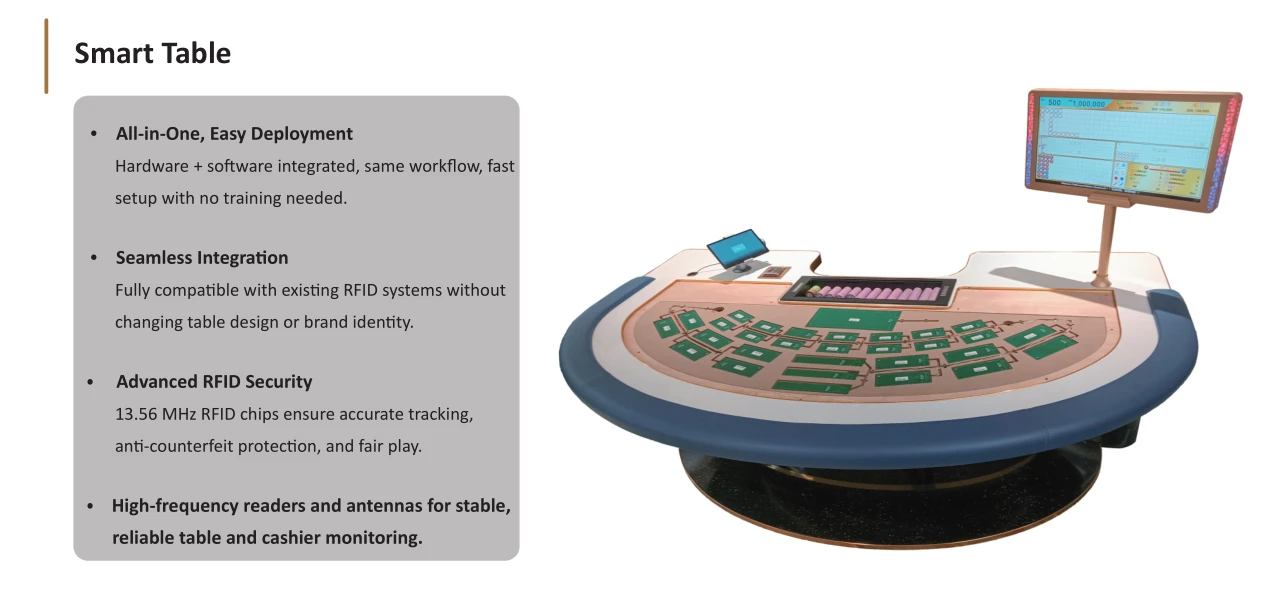
As covered in related discussions of table tracking, RFID antennas embedded in gaming tables monitor chips during active play. This table-level data feeds into the chip management system, maintaining visibility even during the circulation phase that traditional processes left unmonitored.
Centralized Management Software
All RFID data—vault counts, cage transactions, fill/credit movements, and table-level activity—flows into a centralized chip management platform. This software maintains a real-time inventory of every chip on the property, tracks the location and movement history of each individual chip, and generates the reports, alerts, and analytics that operations and compliance teams require.
Inventory Control: From Periodic Audits to Continuous Verification
The most immediate transformation RFID delivers is in inventory control. Traditional chip inventory management relied on periodic manual audits—vault counts performed at scheduled intervals, cage reconciliations at shift boundaries, and table counts that were labor-intensive and infrequent. Between audits, the inventory was effectively invisible.
RFID chip management replaces periodic audits with continuous verification.
Automated Vault Counting
Vault readers can scan entire chip inventories on demand or on schedule, producing a complete count of every chip stored, organized by denomination, series, and batch. This count is automated, instantaneous, and error-free compared to manual counting. It can be performed as frequently as the operator requires—daily, per shift, or on demand—without adding labor cost.
Real-Time Inventory Position
The management platform maintains a live inventory position that shows exactly how many chips of each denomination are in the vault, in the cage, on each table, and in active circulation. This real-time view eliminates the inventory gaps that manual processes created and gives operations managers the data they need to make immediate decisions about float sizing, denomination ordering, and floor-level chip allocation.
Discrepancy Detection and Alerting
When the system detects a discrepancy—a chip count that does not match the expected inventory position, a chip that appears in an unexpected location, or a denomination imbalance—it generates an alert immediately. This transforms discrepancy investigation from a retrospective exercise (discovering a problem hours after it occurred) to a real-time response (identifying and addressing the problem as it happens).
Inventory Forecasting
With continuous inventory data, the management platform can project future inventory needs based on historical patterns, seasonal trends, and real-time floor activity. This enables proactive ordering and denomination planning rather than reactive responses to unexpected shortages.
Anti-Counterfeiting Protection
Beyond inventory control, RFID chip management delivers a powerful layer of anti-counterfeiting protection that is fundamentally different from—and far stronger than—traditional visual authentication methods.
The Counterfeiting Threat
Casino chip counterfeiting is a persistent and evolving threat. Counterfeiters have historically exploited the limitations of visual authentication—matching color, weight, texture, and edge markings to produce chips that pass casual inspection. Even sophisticated visual security features (UV markings, microprinting, holographic inlays) can be replicated by determined adversaries with access to modern manufacturing technology.
The fundamental problem with visual authentication is that it depends on human perception under time pressure. Dealers handling hundreds of chips per hour cannot reliably inspect every chip for subtle counterfeiting indicators, and even trained security staff conducting spot checks cover only a fraction of the chips in active circulation.
RFID Authentication: Cryptographic Identity
RFID authentication operates on a completely different principle. Rather than relying on visual characteristics that can be observed and replicated, RFID authentication depends on cryptographic identity that cannot be cloned or forged by external adversaries.
Each RFID tag embedded in a legitimate chip carries a unique digital identifier that is programmed during manufacturing and locked using cryptographic security mechanisms. Leading casino-grade RFID tags support encryption and digital signature protocols that make the tag’s identity verifiable but not reproducible. When a reader interrogates a chip, it receives not merely a serial number but a cryptographically authenticated response that confirms the tag is genuine.
This means that a counterfeit chip—even one that perfectly replicates the visual appearance of a legitimate chip—will fail RFID authentication because it lacks the embedded cryptographic tag. The counterfeit might look identical to a human observer, but it will be instantly identified as fraudulent by the RFID reader.
Automated Authentication Across the Floor
RFID readers at cage windows, table surfaces, fill/credit transfer points, and vault access zones authenticate every chip that enters their read zone. This authentication is automated, continuous, and comprehensive—it does not depend on a dealer’s attention, a supervisor’s spot check, or a scheduled audit. Every chip, every time it is read, is verified against the property’s chip registry.
Counterfeiting Detection Workflow
When the system encounters a chip that fails authentication—no tag response, an unrecognized identifier, or a failed cryptographic verification—it triggers an immediate alert. The alert identifies the chip’s physical location, the reader that detected it, and the nature of the authentication failure. Security staff can respond in real time, isolating the suspect chip and investigating its origin before it can circulate further.
Reactive Counterfeiting Response
In addition to detecting individual counterfeit chips, RFID management systems support broader counterfeiting investigations. By analyzing the movement history of suspicious chips—where they first appeared, how they were introduced to the floor, and which tables or positions they visited—security teams can identify patterns that reveal the method and scope of a counterfeiting operation.
Operational Efficiency Gains
RFID chip management delivers measurable efficiency gains that reduce labor costs and accelerate workflows across the chip lifecycle.
Vault Audit Time Reduction
Automated vault counting reduces audit duration from hours to minutes. This frees vault staff for higher-value tasks and enables more frequent auditing without increasing labor requirements.
Fill and Credit Processing Acceleration
RFID-tracked fills and credits are logged automatically, eliminating the manual documentation that previously required cage staff to record each chip individually. The transaction record is generated by the system, reducing processing time and eliminating transcription errors.
Shift Reconciliation Automation
End-of-shift chip reconciliation is one of the most time-consuming manual processes in table game operations. RFID systems generate automated reconciliation reports that compare expected chip positions against actual counts, flagging discrepancies for investigation and confirming matches for closure. This reduces reconciliation time and improves accuracy simultaneously.
Reduced Chip Fill Frequency
Optimized float allocation—driven by real-time inventory data—reduces the frequency of chip fills and credits. Fewer fills mean fewer interruptions to game play, lower labor costs for transfer processing, and reduced exposure to transfer-related errors and security risks.
Security Beyond Counterfeiting
RFID chip management addresses security concerns that extend beyond counterfeiting:
Chip Theft Detection
When chips are removed from authorized locations without a corresponding fill, credit, or transaction record, the inventory discrepancy triggers an alert. This enables rapid detection of chip theft—from vaults, cages, or tables—and supports investigation with detailed movement data.
Unauthorized Movement Tracking
RFID readers at access points can detect chips moving through unauthorized pathways—such as chips leaving the vault without a logged transfer, or chips appearing on tables that did not receive a corresponding fill. These detections reveal unauthorized movement that visual security measures cannot track.
Employee Accountability
The chain-of-custody records that RFID creates for every chip transfer establish clear accountability for every employee who handles chip inventory. This deters internal theft and supports investigation when discrepancies occur.
Post-Incident Forensics
When a security incident is discovered—even retrospectively—the RFID system’s historical data enables forensic analysis. Investigators can reconstruct the complete movement history of any chip, any denomination, or any table over any time period, identifying the sequence of events that led to the incident.
Implementation Strategy
Successful RFID chip management implementation requires strategic planning across several dimensions.
Chip Design Integration
RFID tags must be integrated into chip manufacturing specifications. This involves selecting tag dimensions and frequencies compatible with chip construction materials, ensuring that the tag does not affect chip weight or balance, and validating read reliability through stacked chips in real-world conditions. Working with a top-tier RFID chip manufacturer ensures that these specifications are met.
Reader Network Design
The reader network must cover all critical inventory control points—vault zones, cage windows, fill/credit transfer paths, and table surfaces. Reader placement must be designed to eliminate coverage gaps while avoiding interference between adjacent readers.
Software Integration
The chip management platform must integrate with the property’s casino management system, financial accounting software, surveillance system, and compliance reporting tools. This integration architecture should be planned early in the implementation process to avoid costly retrofitting later.
Phased Deployment
Most successful implementations follow a phased deployment model: starting with vault and cage infrastructure, extending to fill/credit tracking, and then expanding to table-level tracking. This phased approach allows operators to validate each layer before building on it, reducing risk and ensuring that each phase delivers measurable value before the next phase begins.
Change Management
Transitioning to RFID chip management changes workflows for vault staff, cage cashiers, pit managers, and compliance officers. Effective change management includes hands-on training, clear communication about what the system does and does not do, and structured feedback processes that capture staff concerns and incorporate them into operational refinements.
Conclusion
RFID casino chip management represents a comprehensive transformation of how casinos control, protect, and optimize their most fundamental financial instruments. From automated vault counting and continuous inventory verification to cryptographic anti-counterfeiting protection and chain-of-custody accountability, RFID technology addresses the vulnerabilities that traditional manual processes could not eliminate. For operators seeking to strengthen security, improve efficiency, and satisfy evolving regulatory expectations, RFID chip management is not an incremental upgrade—it is the new standard of operational excellence.
FAQ
Can RFID chip management track every individual chip on a property?
Yes. Each chip carries a unique RFID identifier, and the management platform maintains a record for every individual chip—from issuance through vault storage, floor distribution, active circulation, and return to the vault. This per-chip tracking enables precise inventory control and detailed movement history for any chip at any time.
How does RFID anti-counterfeiting protection differ from visual security features?
Visual security features—such as UV markings, holographic inlays, and microprinting—can be replicated by determined counterfeiters and depend on human inspection under time pressure. RFID authentication relies on cryptographic identity embedded in the chip that cannot be observed, copied, or forged externally. A counterfeit chip that looks identical to a real chip will fail RFID authentication because it lacks the genuine embedded tag Macaumr RFID Solutions.
Does RFID chip management require replacing existing chip inventory?
In most cases, yes. RFID tags must be embedded during chip manufacturing, so existing non-RFID chips cannot be retrofitted. However, many operators manage the transition by introducing RFID chips for new issuances and gradually phasing out non-RFID inventory, rather than replacing the entire inventory simultaneously.
How does RFID handle chips that are damaged or have degraded tags?
When a chip’s RFID tag becomes unreadable—due to physical damage, extreme wear, or technical degradation—the system flags the chip during the next read event and prompts manual verification. The flagged chip is then removed from circulation and replaced. Most systems also support periodic tag health assessments that identify degrading chips before they fail completely.
What data does RFID chip management generate for regulatory compliance?
The system produces automated records covering vault inventory positions, cage transaction logs, fill and credit documentation, table-level chip counts, and individual chip movement histories. These records are machine-generated, timestamped, and tamper-resistant—providing regulatory bodies with comprehensive, auditable documentation that far exceeds what manual processes can deliver.
Can RFID chip management integrate with surveillance systems?
Yes. Modern RFID management platforms can share data with surveillance systems, enabling correlation between chip movement events and video records. For example, when a chip discrepancy is detected, the system can automatically retrieve the surveillance footage corresponding to the time and location of the anomaly, accelerating investigation and providing visual corroboration of chip movement data.
What is the typical return on investment timeline for RFID chip management?
ROI timelines vary based on property size, existing infrastructure, and the scope of deployment. Most operators report measurable efficiency gains within the first quarter of full operation—primarily from labor reduction in vault auditing, fill/credit processing, and shift reconciliation. Security and compliance benefits, while harder to quantify in direct financial terms, deliver significant risk reduction value that compounds over time.

